Showing posts with label Belgian Tripel. Show all posts

Wednesday, November 2, 2011

#24 Buster's Bitter (Batch No.2) / Bottling the Belgian Tripel / Baking "Mashed" Bread

The Scottish Wee Heavy
For what will most likely be my last brew with this particular pitch of Wyeast of 1968 London ESB ale yeast, I wanted to brew another batch of a beer I brewed last fall in honor of my grandfather. The beer last year was brewed with the 1968 strain and came out great, so I wanted another chance to brew this beer with a few tweaks.

The malt bill for this beer was formulated to a certain extent out of necessity. I'm planning on making a move soon, and I'm not sure I'll have the chance to brew all-grain batches once I move. There's a fair amount of base grain and a few specialty grains I am looking to use up, so the base came from the remainder of a bag of British 2-row, some American 2-row, and some Carastan malt (aka British Crystal). I liked the influence of American Special Roast Malt so much in the Ordinary Bitter that I chose to put a small amount in this grain bill too. The Carastan, American Special Roast, and Crystal 120 are substitutes for Aromatic Malt, and Crystal 60 that I used in the previous batch. I chose to use the same hops but with a different hopping schedule; I chose not to "pepper" in hops as I had with the previous brew, but keep Northern Brewer as a bitter/flavor hop and let the EKG and Fuggles do all the aroma and dry hopping. The first batch of Buster's Bitter finished with a gravity that was a bit too low for my taste, so I chose to lower the mash temp as well this time around.

Buster's Bitter (Batch No.2)

Batch Volume (Gal): 6.0
Pre-Boil Volume (Gal): 7.0

Total Grain (Lbs): 14.5
OG: 1.065   Anticipated FG: ~1.012   Anticipated ABV: ~7% ABV

IBUs: 46
SRM: 11.3
Brewhouse Efficiency: 74%
Boil Duration: 95 min

Grain                                                  (Lbs/oz.) (%)
Malteurop North American 2-row        7       48.3
Pearl British 2-row                                  5       34.5
Carastan Malt                                           1        6.9
Wheat Malt                                             8 oz.    3.4
Victory Malt                                            8 oz.    3.4
Crystal 120                                              4 oz.    1.7
American Special Roast                         4 oz.    1.7

Hops                      (AA%) (IBU) (Oz.) (Boil[min])
Northern Brewer  12.3      41.3    0.8        90
Northern Brewer  12.3       4.8     0.2        30
EKG                         4.5          0      0.5         0
Fuggles                    4.0          0     0.5          0
EKG                         4.5          0      0.5    Dry Hop
Fuggles                   4.0          0      0.5     Dry Hop

Yeast
Repitched ~115 mL of thick, moderately clean 1968 London ESB yeast slurry from Black Butte Porter yeast cake

Water
Ca: 100 Mg: 2 SO4: 134 Na: 25 Cl: 81 HCO3: 84
Mash Schedule
Single Infusion   5 min 140 F, brought up to 150 F 10 min, brought up to 152 F at 15 min, 
15 min mashout at 165 F 
In Mash: 3 mL of Lactic Acid; pH ~5.4
In Boil: 2 g NaHCO3, 6 g CaSO4, 4 g CaCl2

Transferring the Porter off of the 1968 yeast cake
Only two issues on this particular brew day; my mashing continues to be a bit unpredictable and I can't seem to buy an oxygen tank that has any oxygen left in it. The mash for whatever reason began at 140 F after targeting 152 F. I have no damn clue how it started out this low; I preheated as I always do, calculated out my strike temp but missed my target by 12 degrees. Luckily I brought up the temp quickly with boiling water, but this low initial temp may likely produce a drier than desired English Extra Special Bitter. The mash pH as well continues to be unpredictable, and I consistently hit 5.4 pH at mash temps. Not sure this is a bad thing as I often hit this pH and produce beers, but I've found that when I hit 5.1 or 5.2, my beers are much crisper, acidic, and generally more like a commercial example of the style than if I hit a slightly higher mash pH.

The new thermowell for the temp probe
For the second time it seems I purchased a disposable oxygen tank that was completely empty. I have no damn idea how this keeps happening; the first O2 tank I bought had plenty of oxygen, and I know these tanks are not meant to be refilled, so I have no reason to believe that I needed to have these tanks filled in the first place. For the second brew in a row, I had to resort to an old method of aeration which this week happened to be simply sloshing the beer around in the carboy. Hopefully there was a sufficient amount of oxygen mixed into the wort when it came time to pitch the yeast.

I am hoping that I'll have at least a few more chances to brew all-grain before my move, with either a Belgian Dubbel brew or a Biere de Noel with the Trappist High gravity planned soon. If not, I may have to wait a while before I'll have the chance to brew again, so I'm happy that the last few batches I've brewed are ready to drink just before winter comes.
________________________________________________

Bottling the Belgian Tripel


Sanitizing the Belgian Corks
After about a month in the carboy I was able to bottle the Belgian Tripel in 750 mL cork and cage Belgian beer bottles. After the failure of many of the bottles of Belgian Biere de Garde to carbonate in the Belgian beer bottles with plastic stoppers, I knew that I had to go with Belgian corks if I was to ever bottle a batch of beer in Belgian bottles. Fortunately, the wine corker I have works quite well with these corks (with a few modifications) and I was able to bottle the entire batch in both Belgian Beer bottles and Belgian "Champage" style bottles.

I added about 5 ounces of cane sugar to prime these bottles with which should carbonate the beer to about 3.0 volumes of CO2. The flat beer tasted fantastic, so I can only imagine with some added carbonation and a slightly colder serving temp, this beer will be great for winter.

Baking "Mashed" Bread
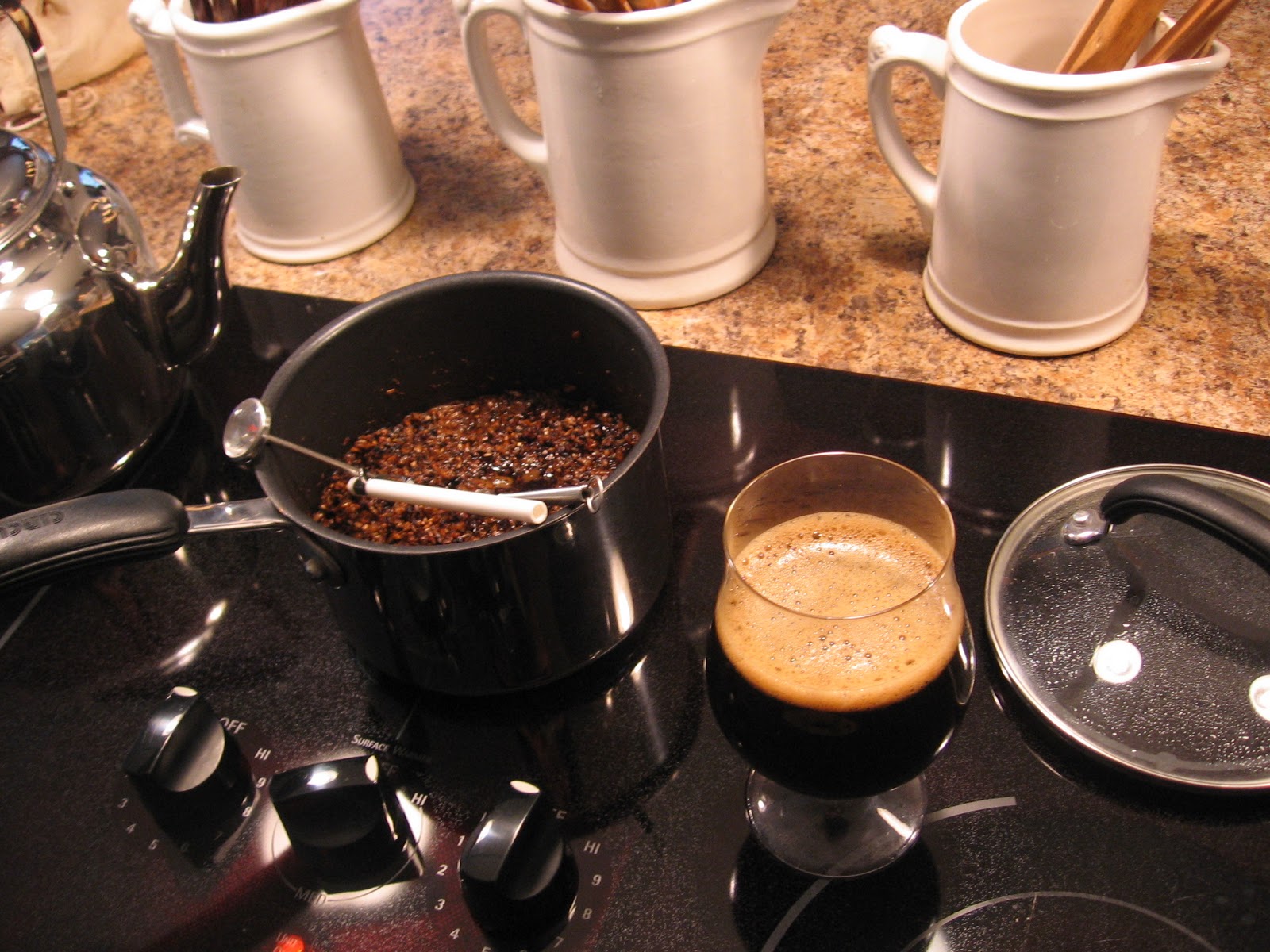
Mashing the Specialty Grains with a glass of Murphy the Stout Hearted
I've baked a few batches of spent grain over the past year, but this time around I wanted to experiment with some extra specialty grain I had lying around. I threw together some wheat, crystal 60, carapils, crystal 120, and a lot of chocolate malt and mashed it all for about 20 minutes on the stove, then proofed my bread yeast using the resulting wort from the mash. This all went into the mixing bowl with bread flower and baked. The bread had the exact color of Chocolate malt and the roastiness of the malt comes through a bit with a lot of chocolate malt flavor. The two loaves taste great, and I'd really like to see what some "mashed" bread would taste like if I went with a crystal malt instead.
The "mashed" grain bread dough

Tuesday, September 27, 2011

#21 Belgian Tripel

The Cascade Wet Hop Harvest Ale
Now with the brewing and serving of O Hike Ale over with, I am excited to get into brewing more outside of the 1056 American Ale brewing. Brewing the test batch of the O Hike, the Terrapin Rye Pale Ale, the American Wheat Ale, the O Hike final batch, and the Wet Hopped IPA has allowed me to brew a lot with the very typical and very common 1056 strain a lot in the last few weeks. It's a grain strain to use; very resilient to any mistakes you make as a brewer and often produces a great beer, but I'd like to produce beers with some additional variety for the fall and winter months.

The Trappist High Gravity 3787 strain from Wyeast should get me out of my American Ale yeast funk. I've wanted to brew either a Belgian Tripel, Belgian Golden Strong, Belgian Quad, and/or a Belgian Strong Dark for some time now, and I think this yeast will make for a fantastic Belgian strong ale if I use it correctly. Since I have a few dark strong ales available at the moment, I thought that a Tripel or Golden Strong would make the most sense, possibly a brew for mid-winter. Jamil Zainascheff had yet another seemingly straightforward yet quality recipe for the Tripel style, so I chose to go with it.

Belgian Tripel

Batch Volume (Gal): 6.0
Pre-Boil Volume (Gal): 7.0

Total Grain (Lbs): 14.25
OG: Post-Boil: 1.060   With additional sugar during fermentation: 1.080
Anticipated FG: ~1.012
Anticipated ABV: ~9.02%

IBUs: 33.8
SRM: 6.8 (most likely darker)
Brewhouse Efficiency: 67%
Boil Duration: 95 min

Grain                                                (Lbs/oz.) (%)
Weyerman German Pilsner Malt       14       83.6
(What I believe to be) CaraAroma    4 oz.     1.5

Cane Sugar (added during ferment)  2.5     14.9

Hops                     (AA%) (IBU) (Oz.) (Boil[min])
Styrian Goldings    4.5      32.8    1.7          90
Czech Saaz              3.0       1.0    0.5           5

Yeast
Propagated 3787 Trappist High Gravity propagator pack three times to produce ~150 mL of yeast. Pitched ~110 mL of thick yeast slurry, pitched remaining yeast from starter diluted with water. Aimed and hit to pitch between 112 mL and 150 mL of yeast. 112 mL suggested pitching rate for 1.060 OG (when fermentation began), 150 mL suggested rate for 1.080 OG (after additions of cane sugar).

Water
Ca: 85 Mg: 2 SO4: 19 Na: 15 Cl: 17 HCO3: 164
(targeted Chimay water profile, carbonates lower than desired)
1 Whirlfloc tablet (5 min)   1/2 tsp yeast nutrient (5 min)

Mash Schedule:
Single Infusion   60 min (roughly 148-149 F, dropping at mash progressed)
10 min mashout at 170 F
1 g NaHCO3, 0.5 g CaSO4, 0.5 g CaCl2, 4.5 g CaCO3,
6.5 mL Lactic Acid (60 min), ~5.4 pH (30 min),
added additional 2.5 mL Lactic Acid (30 min, ~5.4 pH (5 min)

Yet another seemingly hellish brewday, but I'll have to see how the beer turns out to make the final judgement. My mill continues to create issues. I think at this point I will have to abandon wet milling altogether, if not for a while and begin wetting the grain to a lesser extent. The mill rollers, even though I am taking much better care of them now, still struggle towards the end of milling. The drill is unable to continue to mill once the rollers have turned the grains to mush. This can't be a good thing for mashing and could be resulting in tannin extraction, although I think overall wet milling has likely decreased tannin extraction. I'm not sure if the failure is the drill being weak, the grain being too wet, or this mill not being capable of handling wet grains. I'll have to go back to dry milling, and at some point, possibly begin experimenting with wetting the grains to a lesser extent.

My mash numbers seemed to be a bit off, and I continue to be a bit confused over what exactly I should be measuring when it comes to mash pH and mash temperature. I chose to measure temperature on top of the grain bed and below as I had on the previous brew. My measured temp I went with was the one I measured below the level of the grain bed (~148 F), but I have little way of knowing what temperature is most significant. I would like to get a thermowell and thermometer and install both in my mashtun, but this may be an upgrade for the future. In the meantime I'll have to monitor some area of the mashtun consistently to get an idea of the final that will be produced. pH was especially confusing since I initially hit a pH of 5.4, then added an additional 2.5 mL of Lactic Acid and still hit the 5.4 mash pH. This is a beer that is more likely to benefit from a "softer" texture, and so I am ok with a higher mash pH, but I am a bit confused as to how adding the additional acid resulted in no pH change. I think this is another area where investing in equipment to measure weight in grams, volume in mL, and a legitimate pH meter may come in handy in the future.
My issue with my mill would not ultimately be my only issue. I again had a stuck mash (2nd time in the last three brews), however this stuck mash was most likely due to me not attaching my outlet tubing in the mashtun to the false bottom with a hose clamp. Since first brewing with this mashtun assembly from Northern Brewer, I haven't been using the hose clamp that clamps the outlet tubing to the false bottom since I had one particular brew where I had a stuck mash due to the outlet tubing being twisted, crimping, and making it impossible for any wort to drain from the mash. In the future, I'll either have to either clamp this tube as I should be doing and make sure not to twist the outlet tubing, or clamp tubing that is unlikely to crimp due to the high temperatures silicone tubing experiences in the mash. This issue, as with the mill, are most likely only frustrations on brew day, and are not likely to result in a lower quality final beer, but the mash issue most likely did result in my lower efficiency (67%). It would make things more enjoyable to avoid issues like this altogether in future brews.

For the first time, I had a blockage in the flow of wort into the fermenter after chilling. I've never had this happen, and after this particular brewday, it didn't really surprise me. With such a small addition of hops, I had not idea how the strainer could be blocked. After using a sanitized ruler to strip away some of the hops from the strainer, I was finally able to collect a little over 5.5 gallons. It looked like it was only hops that clogged the filter, not protein. I'm thinking this is most likely due to not allowing enough time for the trub to settle to the bottom before draining the boil kettle. Again, I'll have to see how the strainer works during the next couple brews, although I've never had an issue with it before so I'm confident it won't be a reoccurring problem.

One issue that I think may be more significant in the resultant beer is the fact that I think I was given CaraAroma malt instead of Aromatic malt at my local homebrew store. I guy filling in for the homebrew store owner I think must have seen "aroma" when I asked for "aromatic" and thought it was the same type of malt. The CaraAroma is much much darker and will likely result in a different flavor, similar to the flavors in a Belgian Dubbel or Belgian Dark Strong, but it will be interesting to see how this malt plays out in a Tripel. The beer came out of the boil kettle a dark amber, so I'm hoping the flavor isn't overpowered by this malt.

Once the equipment I have ordered for the fermentation chamber arrives, I hope to keep this fermentation under control as I add the additional cane sugar needed to dry out and strengthen this brew. Then, I may or may not repropagate this particular yeast, and either try brewing a dubbel or dark strong for the colder months.